
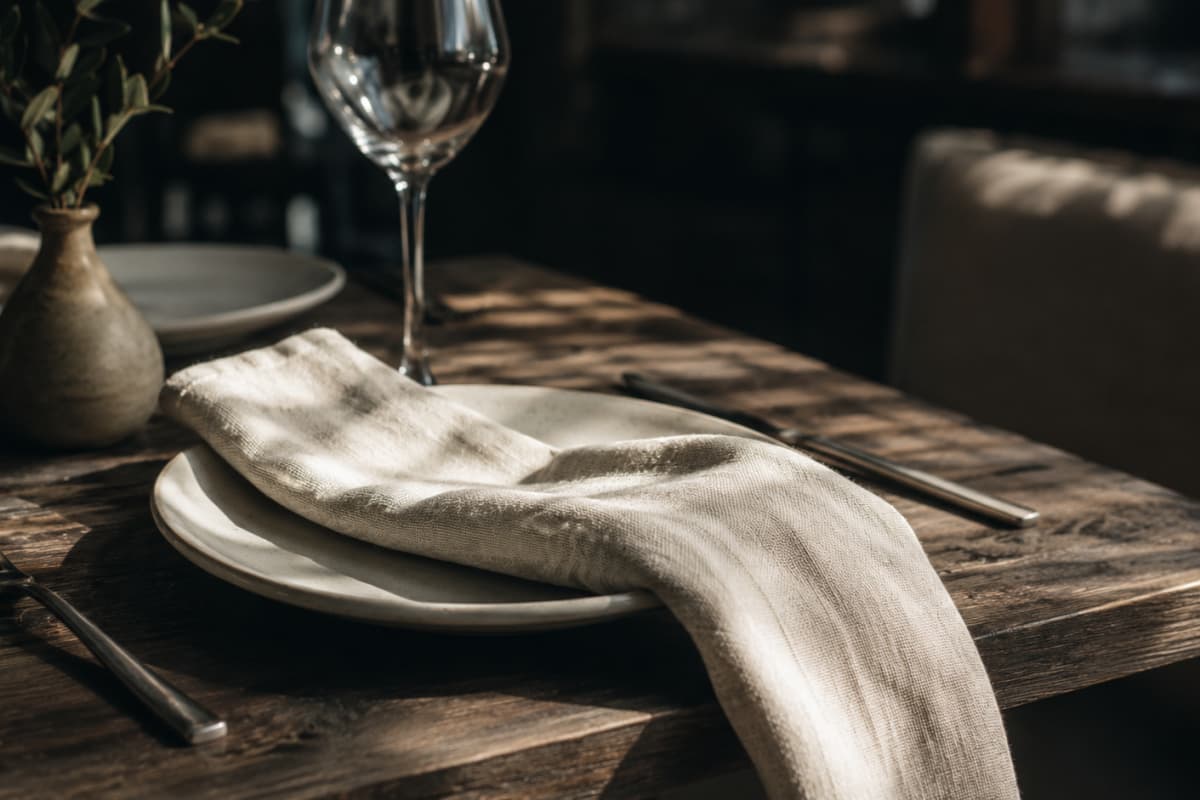
What Kind of Cloth Napkins Do Restaurants Use? The 2026 Professional Purchasing Guide
With countless napkin options on the market, how do you choose the perfect fit for your restaurant? Many purchasing managers often find themselves overwhelmed by the choices. This guide breaks down the essential factors—material, size, GSM, and inventory quantity—to help restaurant owners, F&B directors, and hospitality buyers quickly source the ideal wholesale cloth napkins for restaurants.
What Kind of Cloth Napkins Do Restaurants Typically Use?
Paper napkins are strictly for fast-food chains like McDonald's or Subway. If you operate a mid-to-high-end dining establishment, Budloop strongly recommends investing in premium commercial grade cloth napkins. Here is a breakdown of the three main materials and their ideal use cases:
100% Linen

Linen napkins offer excellent drape, a distinct natural texture, and an inherent sense of luxury. For restaurants aiming to elevate the guest experience,linen restaurant napkins bulk available. It is widely recognized as the definitive choice for the best cloth napkins for fine dining.
Ideal Scenarios:
- Fine Dining Restaurants
- Boutique Hotels
- Upscale Banquets
- Wedding Venues
100% Cotton
Cotton is the most common napkin material in the North American hospitality industry. Its advantages include a soft hand-feel, easy ironing, and a relatively lower cost. For establishments dealing with heavy grease and requiring high-frequency wiping, such as Tomahawk steakhouses, cotton remains a traditional choice for bulk restaurant napkins.
Ideal Scenarios:
- Casual Dining
- Chain Restaurants
- Cafés
- Neighborhood Bistros
Poly-Cotton Blend
The characteristics of this material are highly specific: it is exceptionally wrinkle-resistant, extremely low-cost, and easy to maintain (rarely needing ironing). However, it has poor water and oil absorbency, cannot hold complex architectural folds, and projects a distinctly "cheap" feel.
Ideal Scenarios:
- Employee Cafeterias
- School Dining Halls
- High-Turnover Operations
Comparison of the Three Materials
In summary:
- If you want to create a premium dining atmosphere and elevate the guest experience, choose 100% Linen.
- If you operate a steakhouse or a restaurant requiring heavy grease wiping, 100% Cotton is your best bet.
- If you are on a tight budget and want to save time on laundering and ironing in a casual setting, opt for a Poly-Cotton blend.
For a clearer visual comparison, here is a breakdown of their characteristics:
| Comparison Metric | 100% Linen | 100% Cotton | Poly-Cotton Blend |
|---|---|---|---|
| Appearance & Texture | Excellent | Good | Fair |
| Durability | Excellent | Good | Fair |
| Comfort | Excellent | Good | Fair |
| Eco-Friendliness | Excellent | Fair | Poor |
| Wrinkle Resistance | Good | Fair | Excellent |
| Initial Cost | High | Medium | Low |
Why Are More Restaurants Choosing Linen Napkins?

In light of the shifting landscape highlighted in the National Restaurant Association's 2026 Industry Report, smart procurement managers are increasingly favoring durable, high-GSM textiles over disposable alternatives.
Although the initial procurement cost of linen is slightly higher, Budloop's sales data from the past two years shows that linen has become the absolute mainstream choice for upscale restaurants. As experienced hospitality linen suppliers, we have summarized the four core reasons based on operational feedback from our partners:
Elevating the First Impression
Linen features a unique matte finish and a natural slub texture. Even when laid flat on bare wood or marble tables, it exudes a sophisticated elegance. This organic visual impact simply cannot be replicated by synthetic textiles.
Aligning with Sustainability Trends
Flax (the plant linen is made from) requires very little water and almost no pesticides to grow. Therefore, utilizing linen napkins helps restaurants communicate a commitment to "sustainability" and "environmental safety" to their patrons.
Lower Long-Term Cost
Most suppliers claim their products can withstand 500 washes. In reality, the vast majority of fabrics (especially cotton) will suffer from fiber breakage, thinning, and pilling after just 100 washes.
However, linen fibers contain natural pectin, meaning they become softer and develop a warmer luster with every wash. With properly reinforced hemming, high-quality linen maintains its premium texture and consistency even after hundreds of cycles. While the initial price is higher, its extended lifespan results in a significantly lower long-term average cost.
Superior Brand Presentation
Ordinary napkins often look glaringly white, reflective, and cheap under HD smartphone cameras and filters. The unique matte finish and elegant drape of pure linen act as a natural, luxurious filter.
When guests snap a photo of a linen napkin featuring your restaurant's custom color or embroidered logo and post it to Instagram or TikTok, it becomes the most elegant and eye-catching mobile advertisement for your brand.
What Size Cloth Napkins Do Restaurants Typically Use?
In the North American hospitality market, understanding standard restaurant napkin sizes is crucial for proper table settings. Generally, the core dinner napkin dimensions universally range between 18 and 22 inches.
How Does Size Impact the Table Setting?
When restaurant managers or purchasing directors select sizes, two hard-core operational logics are at play:
Lap Coverage — The Key to Guest Dignity
In Western dining etiquette, the dinner napkin must be placed on the lap immediately upon seating to protect clothing from meat juices, melted butter, or crumbs. If an 18" napkin is used, a broadly built guest shifting slightly will cause it to slip off, compromising the experience. A 22" napkin, however, drapes securely and feels substantial, offering perfect protection for high-end dresses or tailored suits. This is the subtle detail in fine dining that makes guests feel their money was well spent.
Folding Potential — The Key to Visual Grandeur
20" and 22" are the optimal sizes for "table art." If a restaurant needs to execute towering crown folds, pyramids, or multi-layered pocket folds (for menus or silverware), the fabric must be large enough. Forcing a complex fold out of an 18" napkin will result in a cramped, stingy look, or it simply won't fold at all due to a lack of width.
Restaurant Napkin Size Reference Guide
To give you a clear overview, we've broken down mainstream sizes by their operational use cases:
| Size (Inches) | Size (cm) | Industry Term | Best Suited For |
|---|---|---|---|
| 10" × 10" | ~25×25 cm | Cocktail / Bar Napkin | Bars, upscale nightclubs, appetizer service, or paired with craft cocktails and afternoon tea. |
| 18" × 18" | ~45×45 cm | Casual Dinner Napkin | Modern bistros, boutique cafés, and fast-casual dining. Perfect for a basic silverware roll-up. |
| 20" × 20" | ~50×50 cm | Standard Dinner Napkin | The "Golden Size" and industry workhorse. Mid-to-upscale full-service restaurants, independent dining brands, and standard banquets. Handles folds well while providing decent lap coverage. |
| 22" × 22" | ~55×55 cm | Fine Dining Napkin | Michelin-starred restaurants, classic steakhouses, luxury weddings, and executive lounges. Ideal for ultimate grandeur and "quiet luxury." |
Note: Many purchasing directors get confused by cocktail napkin sizes—what exactly is the difference between 5-inch, 6-inch, and 10-inch options on the market? If you want to thoroughly understand cocktail napkin sizing, check out our in-depth guide: Cocktail Napkin Size: The Complete Guide for Buyers, Embroiderers & Event Planners.
What is the Best GSM for Restaurant Cloth Napkins?
Why You Must Check GSM When Sourcing Napkins
GSM stands for Grams per Square Meter. In commercial wholesale purchasing, GSM directly dictates three core lifelines of a napkin:
- Texture and Visual Tier: Low-GSM napkins look flimsy on the table; you might even see the table's grain right through them, which instantly cheapens the restaurant's vibe. High-GSM napkins offer perfect drape and a substantial thickness that instantly elevates the table's prestige.
- Water and Oil Absorbency: A higher GSM means more fibers per square inch. When dealing with the heavy grease and sauces of North American meat-centric menus (like steaks and ribs), high-GSM, inherently stain resistant restaurant napkins act like sponges, rapidly absorbing oil and moisture without instantly soaking through.
- Commercial Laundering Lifespan: Restaurant napkins endure high-frequency washing and pressing. Low-GSM napkins will thin out, fray, or develop holes after just a few washes. High-GSM fabrics feature a tighter structure that easily withstands rigorous laundering.
Recommended GSM Table
For your sourcing convenience, Budloop has summarized our test results for various cotton and linen GSMs below:
| Dining Scenario | Recommended GSM |
|---|---|
| Low-budget bistros (Silverware Roll-ups) or outdoor fast-casual | 150–170 GSM (Cotton) or 130–150 GSM (Linen) |
| American full-service casual, standard banquets, classic diners | 180–210 GSM (Cotton) or 160–170 GSM (Linen) |
| Upscale steakhouses, fine seafood, private business clubs, luxury hotel ballrooms | 220–260 GSM (Cotton) or 210–220 GSM (Linen) |
How Many Cloth Napkins Should a Restaurant Buy?
To escape the heavy burden of washing and pressing, many restaurateurs initially rely on traditional weekly linen rental services like Alsco or Cintas. But as restaurants upgrade, operators quickly realize: these uniform, cheap linens not only render table aesthetics mediocre, but the uncontrollable "damage fees" and "fuel surcharges" hidden in contracts silently eat away at net margins.
When you decide to break free from rentals and transition to Direct Purchase, it is not merely a disruptive upgrade to your visual aesthetics; it is a shrewd financial investment with an ROI cycle of just 12 months, continuously unlocking profit margins for the future.
For operators mastering restaurant linen inventory management, balancing daily turn with emergency stock is a science. Budloop offers a battle-tested formula for calculating and maintaining your optimal stock par level restaurant:
First, determine your base Stock Par Level (1 PAR) based on your peak Friday/Saturday consumption (e.g., if you serve 250 guests on your busiest night, 1 PAR = 250 napkins).
To ensure the executive chef never delays service on a chaotic Saturday night due to a napkin shortage, we recommend configuring a safety stock of 3.5 to 4 PAR (based on your peak weekend volume).
Why 3.5 to 4 PAR?
Most people say "3 PAR is enough"—one on the table, one in the laundry, one in the storeroom. But in actual North American hospitality operations, experienced GMs and suppliers advocate for 3.5 to 4 PAR. We must be candid: advising an extra 0.5 to 1 PAR is not a sales gimmick. It is a critical operational safety net designed to protect your restaurant against two very real risks:
- The Laundry Weekend Black Hole: If you outsource washing, North American commercial laundries typically do not deliver on Sundays, or they severely reduce weekend routes. This means soiled napkins from Friday night and Saturday pile up in the back-of-house like a mountain, waiting until Monday or Tuesday to be processed. If you only have 3 PAR, your supply chain will completely break down by Sunday or Monday. You must have that 4th PAR in the storeroom to survive the laundry's weekend hiatus.
- The Unplanned Catering Cushion: Independent restaurants frequently land spontaneous, highly lucrative buyouts, corporate dinners, or family gatherings. When these premium orders hit, you absolutely cannot refuse them or downgrade your table setting simply because you lack linens. A 4 PAR inventory gives the manager the absolute confidence to handle sudden influxes of guests.
Core Purchasing Advice
If your restaurant operates an in-house laundry with highly predictable daily traffic, 3 PAR will suffice. However, if you rely on outsourced commercial laundering (facing weekend delivery empty windows) and frequently host high-profit, unexpected banquet buyouts, you must configure a 3.5 to 4 PAR safety stock to ensure fail-proof operations.
What to Focus On When Buying Restaurant Napkins in Bulk?
We have streamlined the core focal points below, allowing you to quickly cross-reference them against your restaurant's operational reality when navigating the restaurant table linens wholesale market.
| Core Consideration | Quick Screening Decision |
|---|---|
| Material | Based on Brand Positioning: • For high-end dining atmospheres: Linen • For "heavy grease" menus: Cotton • For cafeterias or tight budgets: Poly-Blends |
| GSM | • For relaxed, organic drape: 160–170 GSM Linen. • For crisp, architectural folds (e.g., pocket folds): 210–220 GSM Linen. |
| Size | Check if the supplier supports both standard industry sizes and custom sizing. |
| MOQ | We recommend selecting suppliers with a low Minimum Order Quantity (e.g., ~50 pieces). |
| Certifications | Prioritize products holding safety credentials like OEKO-TEX®. |
| Samples | Always request physical samples to verify fabric quality and hemming details before finalizing bulk orders. |
Frequently Asked Questions (FAQ)
Q: What is the best fabric for restaurant napkins?
A: It depends on your restaurant's positioning. 100% European Linen is the gold standard for fine dining, offering an authentic luxury texture that synthetic blends cannot replicate. When a business model prioritizes strict budgets over the guest experience, paper napkins or spun polyester remain the industry default.
Q: What size are restaurant cloth napkins?
A: Commercial standard sizes depend entirely on the formality of your service:
- 16" x 16" or 18" x 18": Ideal for casual bistros, high-volume daily turnarounds, and wrapping flatware.
- 20" x 20" or 22" x 22": The premium hospitality benchmark for fine dining and wedding banquets. It elegantly drapes over a guest's lap to protect clothing and holds crisp architectural folds effortlessly.
Q: What defines a high-quality commercial cloth napkin?
A: True commercial-grade quality relies on three core markers:
- Hemming Craftsmanship: Hems should be neat, clean, and free of loose threads.
- Weight (GSM): For premium linen, 160 GSM is the minimum requirement; anything lower will feel flimsy. Linen in the 160–220 GSM range ensures the perfect structural "bone" for folds without feeling too rigid against the mouth.
- OEKO-TEX® Standard 100 Certification: A strict ecological safety credential guaranteeing that every yarn has passed rigorous testing for harmful substances, meeting top-tier safety standards for human health.
Q: What is the best material for restaurant tablecloths?
A: For modern minimalist or "relaxed luxury" dining concepts, 100% Linen holds an unrivaled advantage. For traditional, classic establishments, opt for heavyweight pure cotton tablecloths. For high-frequency event spaces or convention banquets, high-grade spun polyester is recommended to maximize stain release and laundering efficiency.
Conclusion
For most professional restaurants, selecting the right cloth napkins isn't just about table aesthetics; it directly impacts the guest experience, operational efficiency, and long-term procurement costs. By factoring in material, size, GSM, durability, and brand image, high-quality linen napkins consistently deliver the highest return on investment over the long haul.
Ready to source premium linen napkins for your restaurant? Request a Free Sample →

Leave a comment
This site is protected by hCaptcha and the hCaptcha Privacy Policy and Terms of Service apply.