
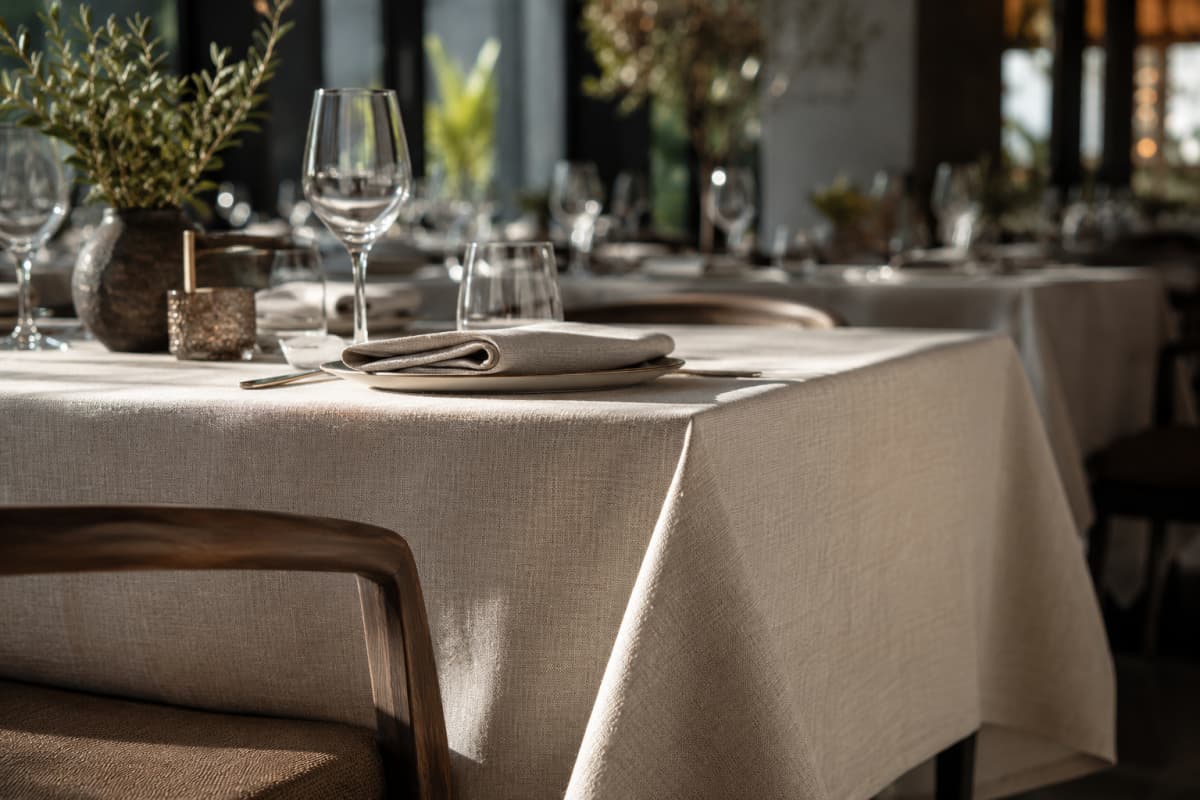
Linen, with its unique natural texture and premium aesthetic, has become a symbol of high-quality living. However, as linen is widely applied across various residential and commercial settings, a classic question consistently troubles every user: Does linen actually shrink?
Frankly speaking: yes, it does. But linen shrinkage is not an uncontrollable defect, nor does it diminish its practical value as a premium material. In this guide, we will deeply analyze the physical mechanisms of linen shrinkage, explore the impact of different washing methods, and detail how to source high-quality linen fabrics to ensure your textiles maintain their perfect shape and texture for the long term.
Why Does Linen Shrink? The Science Behind the Fabric
First, we need to clarify a common misconception: shrinkage is not a trait unique to linen, but rather a physical commonality shared by the vast majority of textiles. According to data from the Budloop Testing Center, even highly stable materials like polyester have a shrinkage rate of around 2%.
To help you make a more scientifically informed decision, Budloop has horizontally compared the shrinkage performance of common materials:
| Material | Shrinkage Rate | Characteristics & Performance |
|---|---|---|
| Polyester | 0%–2% | Extremely stable. Rarely shrinks with water/heat. Top choice for low-end commercial tablecloths. |
| Cotton | 3%–5% | Noticeable shrinkage on first wash, then stabilizes quickly. Highly prone to shrinkage in hot water. |
| Linen | 3%–10% | Higher shrinkage rate, but predictable. Mainly occurs in the warp (lengthwise) and is most noticeable in the first few washes. See our full Linen vs Cotton comparison guide for a deeper material breakdown. |
| Rayon/Viscose | >10% | Extremely unstable. Fiber strength drops when wet; shrinks drastically and irregularly with heat. |
| Wool | Up to 20%–50%+ | Worst (most destructive). Hot water and friction cause "felting," locking fibers permanently. Irreversible. |
Why Do We Have the Illusion That "Linen Shrinks the Most"?
In various space applications, people rarely compare linen to delicate fabrics like wool. Instead, they are accustomed to comparing it with the most common synthetic fibers (like polyester) or pure cotton. This comparison bias is the exact root of the illusion that "linen shrinks the most."
-
The "Industrial Stability" of Synthetic Fibers
Many people are used to polyester tablecloths or home textiles. Because of their stable molecular structure, these synthetics carry almost no shrinkage risk. The shrinkage rate remains below 2% year-round and stops changing after the first wash. In contrast, untreated natural linen will experience a 5%-10% natural contraction when initially exposed to water and mechanical force. This contrast often creates a psychological gap for users accustomed to the "one-and-done" nature of synthetic fibers. -
The "Industrial Processing" of Pure Cotton
Most commercial pure cotton fabrics on the market are rigorously treated with chemical anti-shrink finishes (such as resin cross-linking) before leaving the factory. These industrial methods artificially lock the fiber length. The core value of linen, however, lies in its natural, breathable, and slightly wrinkled premium texture. To preserve this natural vitality, high-quality linen typically avoids chemical coatings that destroy the fiber's inherent characteristics.
Therefore, the "natural pullback" it exhibits after washing is actually the process of the fibers physically returning to their original, relaxed state, rather than a defect in fabric quality.
Will Linen Keep Shrinking Forever?
To answer your concern directly: No.
To understand why linen shrinks, we must return to its physical essence. During the weaving process, linen fibers are repeatedly stretched and tensioned by mechanical forces. When these fabrics first come into contact with water and heat, the fibers act as if they have been "released," actively reverting to their most natural and comfortable length. In textiles, this phenomenon is known as "Relaxation Shrinkage."
This structural change almost exclusively occurs during the first few washes. After that, the fiber structure tends to stabilize.
As a premium linen supplier, Budloop deeply understands the importance of dimensional stability for commercial operations and residential aesthetics. Therefore, we introduce rigorous pre-washing and pre-shrinking technologies during the fabric formation stage, strictly controlling the shrinkage rate within a safe threshold of 2%-5%, ensuring every piece of linen you receive maintains its perfect texture for the long term.
Does Linen Shrink in the Wash?
This is the most common question clients have when purchasing linen products for the first time. The direct answer is: Linen is indeed affected by washing methods, but "shrinkage" is by no means uncontrollable. For a complete breakdown of commercial washing protocols, see our guide on how to wash tablecloths and restaurant linens.
Whether linen experiences significant shrinkage during washing primarily depends on two core variables:
Water Temperature
Linen fibers are highly sensitive to temperature. Cold or warm water (typically, for marketing purposes, other manufacturers suggest below 40°C / 104°F, but Budloop's experience indicates it is best not to exceed 35°C / 95°F) is the ideal washing environment for linen. It effectively protects the fiber structure and prevents excessive "relaxation shrinkage" caused by thermal expansion and contraction. Conversely, hot water will directly disrupt the fiber's equilibrium, causing even high-quality linen fabrics to undergo visible shrinkage.
Mechanical Agitation (Friction)
Excessive and rigorous agitation or high-speed spinning forces the fibers to tangle and contract while wet. For large textiles like restaurant linens or premium curtains, we generally recommend using a Gentle Cycle.
In commercial operations, standardization is the best defense against shrinkage. By setting uniform wash cycles (e.g., low temperature, medium-low spin speed), you can stabilize the shrinkage rate within a minimal range. For residential use, there's no need to change your lifestyle for a few linen pieces; simply avoid the two pitfalls of "high heat" and "violent agitation" during the wash.
The Budloop Linen Standard
While washing methods are important, the ultimate safeguard lies in the product itself. Budloop insists on selecting high-quality French and European long-staple flax and subjects the fabric to rigorous "pre-washing and pre-shrinking" treatments. Our products are OEKO-TEX Standard 100 certified, meaning we use purely physical processes to stabilize the fibers early on, without relying on harmful chemical anti-shrink agents, which significantly reduces the risks associated with your daily care routine. This means that even if your washing process is occasionally imperfect, Budloop's highly pre-treated linen will not suffer disastrous structural deformation.
Does Linen Shrink in the Dryer?

If using a traditional "high-heat drying" setting, undoubtedly, yes. Because when scorching heat forces the moisture inside the fibers to evaporate rapidly, linen undergoes acute "structural tightening." Just as a person instinctively curls up when thrown into an extremely hot environment, linen fibers rapidly contract under the duress of intense heat.
Many ask: "In commercial settings or fast-paced modern homes, avoiding the dryer is unrealistic. Can linen really not be tumble dried?"
The answer is: It can be dried, but you must use the correct method. If you must use a dryer, please follow these guidelines:
- Stick to the "Low Heat" Setting: The "Low Heat" or "Tumble Dry Low" setting is a safe haven for linen. High temperatures thoroughly destroy the natural elasticity of linen fibers, while low heat ensures moisture evaporates slowly, minimizing stress-induced shrinkage.
- Avoid Over-drying (The 90% Rule): Linen does not need to be baked "bone dry" like synthetic fibers. Removing it when it is slightly damp (about 90% dry) not only effectively prevents shrinkage but also keeps the linen soft, reduces wrinkles, and can even save you from tedious ironing later.
- Commercial-Grade Pre-treatment Safeguards: Use premium fabrics that have been pre-shrunk. This is the core advantage of Budloop products. Because we apply stringent pre-shrinking treatments before leaving the factory, your linen products boast a far superior "dryer-tolerance" compared to ordinary linen on the market.
Even so, Budloop still advises avoiding direct high-heat drying in professional care routines, because respecting the fiber is the best investment you can make to extend the lifespan of any premium textile.
What is the Shrinkage Rate of 100% Pure Linen?
To answer this, we need to look at two scenarios: untreated raw linen vs. industrial pre-treated commercial-grade linen.
Untreated Raw Linen
The universally recognized natural shrinkage rate in the industry ranges from 5% to 10%. Under a few specific weaving techniques, it can even reach around 12%. This means if you purchase completely untreated raw linen, the fabric will undeniably experience noticeable shrinkage after its first deep wash.
Professionally Pre-treated Linen
Through industrial-grade pre-washing and pre-shrinking technologies, premium linen fabrics release their fiber tension before they ever reach your hands. General suppliers will market their fabrics as having a controlled shrinkage rate of 1% to 3%. However, through Budloop's extensive testing of multiple brands on the market, we found this is mostly a marketing claim; the true shrinkage rate is typically between 3% and 5%.
Nevertheless, a 3%-5% variation is virtually imperceptible to the naked eye in practical commercial operations. This means that if you are a restaurant owner, or custom-ordering curtains and bedding, this 3%-5% stability is the baseline for maintaining spatial aesthetics.
A Detail Worth Noting: Directional Shrinkage
Budloop's fabrics typically undergo 3 to 5 rounds of pre-shrinking treatments. Lab tests confirm that our shrinkage rate can be stably controlled between 2% and 5%. When you choose rigorously pre-treated linen like Budloop's, you are essentially purchasing "dimensional stability," avoiding after-sales headaches like tablecloths "getting too short" or bedding "losing its shape" due to washing.
At the same time, as linen experts, Budloop advises you to look not only at the overall shrinkage rate but also at the "directional variance." Linen fabrics usually shrink more in the warp (lengthwise) direction than in the weft (widthwise) direction. This is because the warp yarns are under continuous tension on the loom; once in a washing environment, the relaxation response of the warp yarns is more pronounced than that of the weft.
How to Prevent Linen from Shrinking?
Linen shrinkage is essentially a "physical property" that can be precisely managed. Whether it's restaurant linens, residential curtains, or bedding, if you want to maintain perfect dimensions and texture over the long term, you can proactively prevent shrinkage from two angles: "sourcing" and "care."
- Choose Pre-washed Fabrics: This is the most effective and thorough "prevention." High-quality linen fabrics should undergo industrial-grade pre-shrinking before leaving the factory.
- Wash with Cold Water: For daily washing, try to avoid hot water above 35°C (95°F). Additionally, use the "Gentle" or "Low Spin" mode on your washing machine to reduce physical friction.
- Air Dry or Tumble Dry Low: If possible, air dry naturally. If you must rely on a dryer, please ensure it is set to "Low Heat" or "Gentle."
- Routine Care: If the linen fabric experiences extremely slight shrinkage, it can be physically restored through ironing. While the fabric is still slightly warm or damp, using a steam iron and applying appropriate lengthwise tension can help the fibers relax and stretch back out.
Why Must Both Commercial and Residential Spaces Care About Shrinkage?
For Commercial Spaces: Consistency is Brand Professionalism
In hotels, restaurants, or high-end event rentals, linens are the focal point of the visual space. If washing causes inconsistent sizing, it not only leads to uneven tablecloth draping but also increases replacement costs on the operational side. For commercial operators, monitoring the shrinkage rate means monitoring ROI (Return on Investment). By strictly sourcing pre-shrunk linen, you ensure your linens maintain uniform dimensions and a premium feel, which is essential for preserving brand professionalism and aesthetics. If you're sourcing napkins for your restaurant, see our guide on what kind of cloth napkins restaurants use.
For Residential Spaces: Quality is the Ritual of Living
If you use linen as home decor (like curtains or bedding), paying attention to the shrinkage rate is a way to protect your "investment." No one wants to see a set of high-quality linen sheets become "shrunken and distorted" after a few washes, or custom curtains lose their graceful hemline due to size contraction. Caring about shrinkage means you can more calmly enjoy the natural comfort linen brings, without the anxiety of tedious maintenance or unexpected dimensional fluctuations.
Linen Shrinkage and Care (People Also Ask)
Q: Should you size up in linen?
A: That depends on whether the fabric has been pre-treated. If you are buying untreated Raw Linen, we recommend allowing about a 5% margin or sizing up. However, if you choose premium pre-shrunk linen like Budloop, its dimensions are already stable, so you can simply purchase your normal size or exact measurements.
Q: How much do linens shrink?
A: After the first wash, untreated linen typically shrinks by 5% to 10%. With commercial-grade linen that has undergone professional pre-washing and pre-shrinking, the shrinkage rate is controlled between 3% and 5%. A select few suppliers, like Budloop, can keep it strictly between 2% and 5%, making the minor change virtually imperceptible to the naked eye.
Q: How many sizes does linen shrink?
A: For untreated linen garments, a 5%–10% shrinkage rate usually equates to half a size to a full size down. For commercial tablecloths or curtains, this could mean the warp (length) shortens by anywhere from a few centimeters to over a dozen.
Q: Does linen naturally shrink?
A: Yes. Linen fibers are stretched during the weaving process. When the fabric first comes into contact with water, the fibers naturally relax and attempt to return to their originally shorter state—a process known in textiles as "relaxation shrinkage." This is a physical trait of pure natural fibers, not a quality defect.
Q: Does linen shrink every time you wash it?
A: No. The drastic structural changes in linen almost exclusively occur during the first 3 to 5 washes. Once the fibers have released their tension through these initial washes and reached an equilibrium, the dimensions will become highly stable in subsequent washes.
Q: At what temperature does linen shrink?
A: Linen is highly sensitive to high temperatures. When the washing water temperature exceeds 35°C (95°F) or 40°C (104°F), the heat directly triggers rapid fiber contraction. To protect the fiber structure, we strongly recommend using cold or warm water for routine washing.
Q: Can you put linen in the dryer?
A: Yes, but you must use the "Low Heat" or "Tumble Dry" setting. To achieve the best texture and longevity, it is recommended to remove the linen while it is still slightly damp (about 90% dry). This effectively prevents the shrinkage and stiffness caused by over-drying.
Q: What happens if you put 100% linen in the dryer?
A: If you use high-heat drying, the scorching heat will force the moisture inside the fibers to evaporate instantly, causing the linen to undergo severe "structural tightening." This not only results in serious, visible shrinkage but also causes fiber fatigue, permanently reducing the fabric's lifespan.
Q: Is linen shrinkage permanent?
A: In the vast majority of cases, yes. Especially with structural tightening caused by extreme heat (like a hot dryer), the internal physical form of the fibers is disrupted, making this type of shrinkage practically irreversible.
Q: How do you fix shrunken linen?
A: If it is only mild shrinkage, you can partially restore it through physical stretching. While the linen is still slightly damp, heat it with a steam iron and apply moderate tension along the warp and weft directions. This helps the fibers relax and regain some of their lost dimensions.
Q: What is the downside of linen?
A: The primary challenges of linen are its tendency to wrinkle and the risk of shrinkage if untreated. However, in high-end hospitality and home aesthetics, the natural, slightly wrinkled look is precisely the hallmark of its premium texture and vitality. Meanwhile, the shrinkage issue can be completely avoided by utilizing industrial-grade pre-shrinking solutions like those provided by Budloop.
Conclusion
In summary, linen is a natural fiber that shrinks under heat and physical friction. However, for commercial purposes, this risk is entirely controllable. The secret lies not just in how you wash it, but in the manufacturing process at the source.
By investing in pre-treated linen from a trusted supplier, you can guarantee batch consistency and long-term durability for your fabrics. If you are looking for high-quality textiles that offer both natural aesthetics and dimensional stability for your brand space, you are welcome to Click here to request a Free Sample of Budloop's Linen to personally experience the real data and premium touch.

Leave a comment
This site is protected by hCaptcha and the hCaptcha Privacy Policy and Terms of Service apply.