
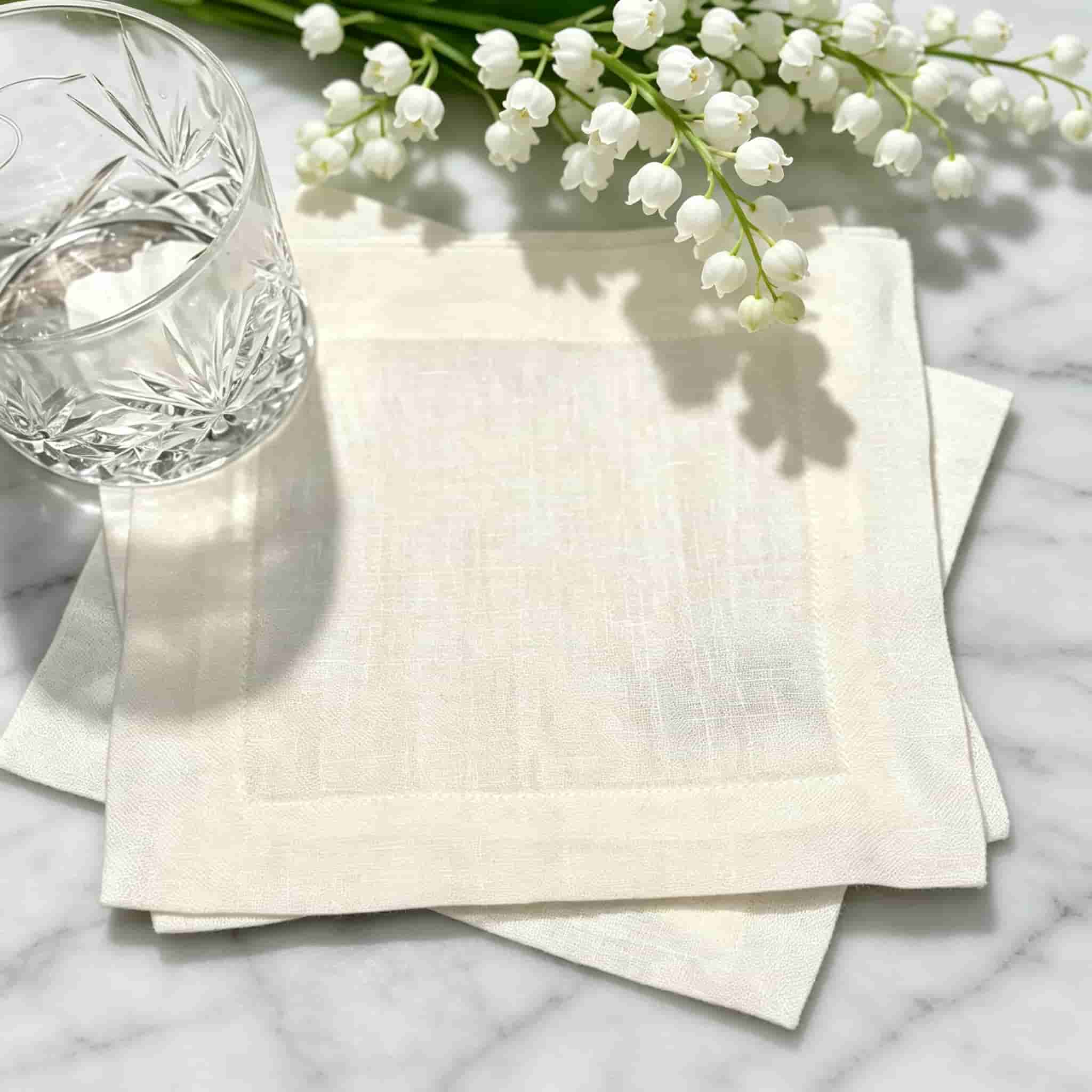
Cocktail Napkin Size Chart: The Complete Guide for Buyers, Embroiderers & Event Planners
A standard cocktail napkin measures 5×5 inches folded (10×10 inches unfolded) for paper, or 6×6 inches (approx. 15×15 cm) flat for premium linen. Beverage napkins and dinner napkins follow different standards — see the full size chart below.
| Type | Inches | CM |
|---|---|---|
| Paper cocktail napkin (folded) | 5 × 5" | 13 × 13 cm |
| Paper cocktail napkin (unfolded) | 10 × 10" | 25 × 25 cm |
| Premium linen cocktail napkin | 6 × 6" | 15 × 15 cm |
| Dinner napkin | 18 × 18" | 45 × 45 cm |
| Luncheon napkin | 14 × 14" | 35 × 35 cm |
In recent years, alongside the widespread adoption of sustainability (ESG) concepts, a growing fatigue toward polluting single-use paper products has emerged. Discerning professionals and hosts are shifting back to reusable, 100% pure linen cocktail napkins that bring a sense of vintage sophistication. However, buyers are frequently confused by cocktail napkin sizes because fabric equivalents follow entirely different rules compared to traditional paper beverage options.
This definitive guide clarifies size specifications, uncovers labeling myths, and details strategic selection frameworks for various commercial applications. Whether you are sourcing bespoke options for weddings, ordering in bulk for upscale lounges and restaurants, or running an embroidery studio seeking premium blank linens for custom monograms or branding—this article provides the ultimate clarity.
What Is the Standard Cocktail Napkin Size?
In the mainstream commercial market, standard cocktail napkin dimensions diverge based on material composition and target application environments:
- 5 × 5 Inches (approx. 13 × 13 cm): This is the classic nominal dimension for single-use paper beverage napkins, expanding to roughly 10 × 10 inches when completely unfolded. Lightweight and compact, it is perfectly scaled to fit beneath a single glass or support delicate hors d'oeuvres.
- 6 × 6 Inches (approx. 15 × 15 cm): This is the gold-standard specification for high-end fabric blanks and bespoke embroidery sectors. It establishes a more pronounced visual presence on tablescapes and provides an elegant, physically secure buffer zone for complex family crests or corporate monograms.
It is crucial to recognize that within the natural textile domain, 100% pure linen exhibits organic moisture absorption and inherent fiber elasticity. Consequently, finished dimensions may experience subtle physical shifts depending on environmental humidity and tension during commercial pressing. For this reason, the global premium textile sector does not enforce the rigid, inflexible standards applied to molded plastics; instead, an Artisanal Tolerance of 1/4 to 1/2 inch is universally accepted. We highly recommend confirming size parameters with your supplier prior to procurement to guarantee absolute alignment with your operational expectations.
At Budloop, we execute rigorous warp-and-weft alignment combined with master artisan cutting techniques to restrict our finished tolerance strictly within 1/4 inch (approx. 0.6 cm). This significantly outperforms the broader 1/2-inch market average, ensuring exceptional consistency across large-scale commercial bulk deliveries.
What Is a Cocktail Napkin?
Fundamentally, what is a cocktail napkin? Simply put, it is a compact, square textile widely deployed in beverage services, cocktail receptions, and for supporting hors d'oeuvres.
The integration of pure linen elevates these functional pieces into multidimensional design statements. In modern commercial contexts, its role has evolved into a medium for quiet luxury, serving social engagement, refined aesthetics, and elegant brand expression. Below are the core applications where linen cocktail napkins truly shine:
The "Tablescaping Aesthetic Code" of Social Media
Across high-end design feeds on Pinterest and Instagram, luxury tastemakers leverage these textiles as crucial transitional design layers. Folded into crisp diamonds or left with a natural linen texture, they are set beneath delicate dessert plates or appetizer bowls to introduce a deliberate bridge of color and texture against expansive tabletops.
Moving far beyond basic utilitarian white, modern trends celebrate low-saturation palettes—including sage green, terracotta, and rich charcoal. When juxtaposed with antique silverware or artisanal hand-thrown ceramics, they instantly curate an atmosphere of effortless, old-money relaxation.
The "Everlasting Keepsake" for Luxury Weddings & Galas
Traditional party favors—like generic sweets or quickly discarded trinkets—are rapidly losing favor. Modern high-end weddings and exclusive private salons favor a sophisticated alternative: presenting guests with custom linen cocktail napkins embroidered with the couple's monogram or the event's bespoke visual emblem to serve as a premium keepsake.
Following the event, the substantial weight and practical utility of 100% pure linen compel guests to bring these elegant mementos home, where they find a second life as premium daily drink coasters. This tradition of allowing a host's curated signature to gently weave into the daily lives of their guests has become exceptionally popular across North American luxury circles.
The "Quiet Luxury" Business Card for Elite Hospitality
Independent fine dining establishments, upscale lounges, and curated designer hotels are completely phasing out paper beverage options. Instead, they rely on high-gram-weight blank linen cocktail napkins featuring minimalist, high-density digital logo embroidery (Miniature Logo Embroidery).
The moment a patron's fingers contact the unmistakable texture of premium French flax adorned with precise stitching, a subtle brand touchpoint is established. This understated gesture communicates luxury infinitely better than loud, overt corporate branding, representing the highest form of respect extended to a discerning clientele.
The Social Totem of Curated Home Salons
In consumer sectors, modern professionals are actively embracing highly intentional micro-gatherings—such as curated Friday movie nights, intimate book clubs, and culturally trending game or mahjong nights.
When a host presents a signature cocktail alongside a beautifully coordinated, high-textured linen napkin that mirrors the evening's theme, this deliberate detail routinely becomes an immediate focal point for guest photography and social sharing.
Are Cocktail Napkin Sizes Measured Folded or Unfolded?
This remains one of the most persistent points of confusion for procurement managers: why does the exact same product alternate between a 5 × 5-inch listing and a 10 × 10-inch listing across supply chain manifests?
For disposable paper options, the dimensions displayed on commercial packaging strictly denote the folded size. For example, a package labeled 5 × 5 inches contains items that span roughly 10 × 10 inches when entirely unfolded.
Conversely, for premium woven textiles like linen or cotton, the overwhelming majority of manufacturers calculate listings based on the flat, finished physical dimensions. A linen option marketed at 6 × 6 inches represents the true physical footprint delivered to your hand—not a pre-folded fraction.
Review the quick-reference matrix below to streamline your ordering:
| Label Size | Standard Supply Chain Meaning |
|---|---|
| 5 × 5 | The folded footprint of a disposable paper beverage napkin. |
| 10 × 10 | The total unfolded physical length and width of that exact same paper napkin. |
| 6 × 6 Linen | The actual, flat physical dimension of a finished cloth napkin ready for use. |
Budloop Expert Advice: Always explicitly cross-verify dimensional definitions with your factory prior to finalizing bulk wholesale purchases, and request physical pre-production samples whenever operational timelines permit.
Standard Cocktail Napkin Dimensions and Size Chart
To empower your procurement team with precise data for upcoming buy programs, we have synthesized a comprehensive comparative framework of the primary specifications available in the international market:
| Size (Flat / Unfolded) | Typical Material | Best-Fit Target Applications | Commercial Procurement Notes |
|---|---|---|---|
| 4 × 4 Inches | Paper / Cellulose | High-volume entry-level catering, airline service trials | Ultra-low cost per unit; highly restricted visual presence. Too cramped for fabric applications. |
| 5 × 5 Inches | 3-Ply Paper / Premium Linen | High-turnover luxury lounges, minimalist casual dining | The most ubiquitous commercial standard; fits neatly beneath standard rocks glasses. |
| 6 × 6 Inches | 100% Flax Linen / Heavy Cotton | Luxury weddings, custom embroidery blanks, boutique hotels | Provides an expansive creative canvas for digitizers; delivers superior premium weight. |
| Bespoke / Custom Sizes | Tailored Flax Linen | Immersive brand launches, targeted ESG corporate gifting | Produced strictly to architectural or event-specific layout criteria. |
If your operational footprint is limited to basic beverage containment, a 5 × 5-inch specification is entirely functional. However, if your program calls for custom monograms, intricate digital embroidery, or complex corporate branding, upgrading to a 6 × 6-inch model provides the requisite design clearance.
How Big Is a Cocktail Napkin Compared to Everyday Objects?
Dimensions on a spec sheet can occasionally feel abstract. To assist visual designers and coordinators in mapping out spatial layouts without a physical sample on hand, consider how a textile option compares to familiar everyday items:
- A Flat 5 × 5-Inch Napkin: The total surface area equates to roughly four standard 3 × 3-inch sticky notes arranged in a square. When laid completely flat, it perfectly conceals a standard compact disc (CD).
- A Flat 6 × 6-Inch Napkin: The length of a single edge corresponds almost exactly with the physical height of an iPhone 15 Pro (approximately 5.8 inches).
How to Choose the Right Cocktail Napkin Size
Determining your ideal specification depends on your brand's market positioning, target cost per event, and intended laundering cycles. We recommend utilizing the B2B persona matrix below to guide your selection:
| Buyer Persona | Recommended Specification | Primary Decision Criteria |
|---|---|---|
| Embroidery Studios & Etsy Creators | 6 × 6 Inches | Maximization of usable design area: Delivers essential clearance for commercial hoops, completely eliminating edge slippage. |
| Luxury Wedding & Event Planners | 5 × 5 or 6 × 6 Inches | Visual premium and tablescape hierarchy: Selected based on monogram complexity and desired negative space on the table. |
| High-Turnover Bars & Lounges | 5 × 5 Inches | Cost-efficiency and standard sizing: Maximizes storage space while matching standard beverage setups. |
| Corporate Gifting Program Managers | 6 × 6 Inches | Logo visibility: Guarantees sufficient area for dual-branded execution without crowding edges. |
| Boutique Retailers & Home Brands | 6 × 6 Inches | Gift-ready presentation value: Projects a substantial, high-margin retail presence on shelves. |
To summarize: if your core objective centers on brand storytelling or subsequent embroidery decoration, the 6 × 6-inch format offers distinct competitive advantages. If your program prioritizes rapid daily volume rotation, the 5 × 5-inch format effectively balances operational cost with functional utility.
What Size Cocktail Napkin Is Best for Embroidery?
For commercial digitizer networks, custom embroidery studios, and independent Etsy brand owners, nominal dimensions are secondary to a far more critical metric: the Embroidery Safe Zone.
This operational reality explains why elite embroidery businesses overwhelmingly mandate 6 × 6-inch blanks over standard 5 × 5-inch variants. Let us analyze this through three core textile engineering principles:
1. The Physical Compression of Edge Finishing
Regardless of style, standard edge treatments consistently decrease the actual surface area available for embroidery machinery:
- Classic Hemstitch: Typically requires an open-work ladder border extending 0.5 inches inward. Deducting this from a 5 × 5-inch piece shrinks the functional interior canvas down to a restrictive 4 × 4 inches.
- Artisanal Scalloped Edge: The curved, decorative satin-stitched border creates an optical illusion of inward compression.
- Clean Solid-Edge (Double-Fold Mitered Hems): While ensuring absolute geometric stability, commercial embroidery hoops require a minimum of 0.75 inches of clear buffer space from the inner hem line. This prevents the needles from shifting or slipping during high-speed, multi-thousand-stitch operations. A 6 × 6-inch blank yields a spacious, uninterrupted 4.5 × 4.5-inch safe zone—ideal for complex family crests or dense multi-colored corporate logos.
2. Accounting for Natural Linen Shrinkage
Authentic, high-grade French flax possesses natural fiber fluidity. Upon undergoing initial industrial or commercial laundering cycles, expect an organic physical contraction of roughly 3% to 5%.
A raw 6 × 6-inch woven blank will naturally stabilize at approximately 5.75 × 5.75 inches after pre-washing and tension setting.
If procurement fails to factor this contraction into their design metrics and executes dense satin embroidery directly onto a smaller 5 × 5-inch commodity cloth, the subsequent washing cycle will trigger severe fiber tension disparities, causing irreversible, unsightly fabric puckering around the design.
3. The Dynamic Relationship Between Material Weight (GSM) and Stitch Tolerance
Fabric density directly dictates the total stitch count a textile can structurally withstand without collapsing:
- 160–170 GSM (Light-to-Midweight Linen): Delivers an airy, elegant hand feel with beautiful light transmission. Outstanding for delicate, fine-gauge lettering and curated gift sets.
- 210–220 GSM (Heavyweight Linen): Exceptionally dense weave with highly stable warp and weft fibers. Purpose-built to handle complex, high-stitch-count 3D monograms and dense commercial embroidery files without distortion.
Seeking Elite Embroidery Blank Solutions? Explore Budloop's professionally curated collection of 5 × 5" and 6 × 6" pure linen cocktail napkin blanks — engineered specifically for custom artisans and commercial embroiderers. Request a Free Sample Kit to experience the quality firsthand.
How Many Cocktail Napkins Do You Need?
Once sizing parameters are established, the next major hurdle for procurement managers is calculating precise order volumes.
For single-use paper options, the baseline industry benchmark dictates preparing 4 to 6 sheets per guest, per hour, given that paper rapidly degrades upon contact with condensation.
Standard Paper Sourcing Reference Table:
| Guest Count | Estimated Operational Consumption | Recommended Order Volume (Inc. Buffer) |
|---|---|---|
| 50 Guests | 200–300 Sheets | 300–350 Sheets |
| 100 Guests | 400–600 Sheets | 600–700 Sheets |
| 200 Guests | 800–1,200 Sheets | 1,200–1,400 Sheets |
When upgrading to reusable, professional linen napkins, their superior absorbency, breathability, and rapid-drying performance allow for a completely different allocation model focused on event rotation and commercial laundering cycles.
Below is our B2B commercial wholesale allocation matrix for premium events (calibrated against typical high-volume paper discard rates):
| Total Guests | Equivalent Paper Discard Rate | Recommended Bulk Linen Sourcing Volume (Inc. Loss Buffer) |
|---|---|---|
| 50 Guests | 200–300 Pcs | 75–100 Pcs |
| 100 Guests | 400–600 Pcs | 150–200 Pcs |
| 200 Guests | 800–1,200 Pcs | 300–400 Pcs |
For permanent hospitality clients running daily food and beverage programs, Budloop recommends our proven inventory safety formula:
Budloop Inventory Safety Formula:
Total Daily Seat Count × 1.5 to 2 = Baseline Safety Inventory Stock
Maintaining this multiplier ensures an optimal operational loop: one segment of your inventory actively services the dining floor, while the remaining allocation is undergoing professional laundering or resting in reserve.
Linen vs Cotton Cocktail Napkins: Does Material Affect Size?
A frequently overlooked factor is how material composition directly influences the long-term dimensional retention of your napkins over repeated commercial wash cycles.
Below is an engineering comparison between 100% authentic French flax linen and standard commercial cotton:
| Product Attribute | 100% French Linen (Budloop Standard) | Premium Commercial Cotton |
|---|---|---|
| Dimensional Stability | Outstanding. Following an initial professional pre-wash process, subsequent shrinkage is locked tightly between 3%–5%. | Moderate. Cotton fibers undergo continuous, progressive contraction when exposed to high-heat commercial drying cycles, averaging a 5% loss. |
| Texture & Body | Crisp and structural with an organic premium texture. Softens beautifully with age while gaining luster after every wash. | Soft and pliable. Tends to lose structural integrity and pill over time, requiring heavy starching to maintain flat edges. |
| Embroidery Suitability | Unparalleled. High-GSM linen fibers easily anchor dense, high-speed digital stitches without warping the surrounding weave. | Prone to minor distortion. High stitch density can pull the softer fabric inward, resulting in localized puckering. |
| Laundering Durability | Maximum. As a premier natural plant fiber, its tensile strength actually increases when wet, surviving hundreds of industrial wash cycles. | High, but the short-staple fibers break down faster over time, eventually showing visible wear and color fading. |
| Luxury Appeal | Universally recognized as the premium choice for editorial tablescapes and high-end hospitality branding. | Commonplace; ideal for utilitarian, budget-conscious environments. |
When evaluating luxury textiles, confirming that the fabric underwent professional pre-shrinking and pre-washing before final cutting is the ultimate benchmark of a reputable B2B supplier. Every linen product manufactured by Budloop relies exclusively on chemical-free, OEKO-TEX® Standard 100 certified French flax lines, maintaining a reliable, predictable post-wash shrinkage curve of just 2%–5%.
Frequently Asked Questions
1. What is the standard size of a cocktail napkin?
The global standard for disposable paper options is a folded footprint of 5 × 5 inches (unfolding to 10 × 10 inches). For premium, reusable cloth alternatives—such as fine linen—the undisputed industry standard is a flat measurement of 6 × 6 inches.
2. What size are cocktail napkins for a wedding?
While both 5 × 5 and 6 × 6 inches are used, luxury event planners across North America overwhelmingly mandate the 6 × 6-inch linen specification. It provides the essential scale needed for custom monograms and works beautifully as a high-end keepsake favor.
3. How big is a cocktail napkin compared to a dinner napkin?
Cocktail napkins (5 × 5 or 6 × 6 inches) represent the smallest size tier in fine dining linens, intended strictly for beverage service. In contrast, dinner napkins range from 18 × 18 to 20 × 20 inches (and up to 22 × 22 inches in ultra-luxury venues), offering a much larger surface area designed to protect guest attire during multi-course meals.
4. What is a cocktail napkin used for?
Its primary functional role is sitting beneath chilled glassware or stemware to absorb condensation and protect fine surfaces. It is also used during cocktail hours for holding finger foods, wiping fingers, and presenting an elegant canvas for brand logos or event styling.
5. Are cocktail napkins the same as beverage napkins?
Yes, the terms are frequently used interchangeably within commercial sourcing. Generally, high-volume paper manufacturers use "Beverage Napkins," while high-end fabric mills, event coordinators, and hospitality designers prefer "Cocktail Napkins."
6. What size cocktail napkin is best for embroidery?
The 6 × 6-inch dimension is universally recognized as the ideal canvas. It preserves a completely flat, tension-stable 4.5 × 4.5-inch Embroidery Safe Zone, ensuring commercial machine hoop clamps have ample clearance from the finished edge treatment.
7. Does 5x5 mean folded or unfolded?
For single-use paper supplies, 5 × 5 inches indicates the folded configuration (expanding to 10 × 10 inches flat). For fine linens or cotton textiles, 5 × 5 inches denotes the absolute, flat physical footprint delivered to your hand.
8. Do linen cocktail napkins shrink after washing?
Authentic 100% linen has a natural shrinkage rate of 3%–5%. Lower-tier unwashed commodity blanks can shrink unevenly and warp out of shape; premium brands like Budloop execute thorough industrial pre-washing and geometric heat-setting to limit long-term shrinkage to a predictable 2%–5%.
9. What is the difference between 160 GSM and 220 GSM cocktail napkins?
GSM measures fabric weight per square meter. A 160 GSM weight offers a light, flowing, and semi-translucent structure—excellent for classic fine-gauge embroidery. A 220 GSM weight signifies an ultra-premium, heavyweight weave that remains perfectly flat and rigid under dense, heavy 3D monograms.
10. Can you embroider a 5x5 cocktail napkin?
Yes, it is possible. However, once you deduct the space consumed by edge treatments (such as a 0.5-inch hemstitch) and necessary hoop clearances, the usable design space drops to roughly 3 × 3 inches, limiting your layout to small, single-letter initials.
11. How many cocktail napkins do I need for 100 guests?
For standard single-use paper variants, plan for 400–600 sheets. For an upscale event utilizing premium reusable linen, a bulk commercial order of 150–200 pieces provides ample coverage for guest service, laundering rotation, and accidental staining buffers.
12. What is the most popular cocktail napkin size?
Across mass consumer retail, paper options sell best at a folded 5 × 5-inch size. However, across premium home boutiques, the Etsy creator economy, and luxury B2B hospitality procurement, the clear favorite is the flat 6 × 6-inch pure linen square.
13. Are scalloped-edge cocktail napkins the same size as hemstitch versions?
Not necessarily. While both styles may share an identical outer 6 × 6-inch physical cut, the visual weight of an artisanal scalloped edge pulls the eye inward differently than an open-work hemstitch. This variation subtly shifts the perceived boundary of the internal design canvas.
14. Where can I buy blank linen cocktail napkins in bulk?
If your brand requires a highly editorial, refined supply chain that avoids cheap synthetic polyester blends, you should partner with dedicated B2B linen experts like Budloop, who specialize in 100% French and Belgian flax fabric production.
15. What size cocktail napkin fits in a standard napkin ring?
Because cocktail napkins (5 × 5 or 6 × 6 inches) have a compact surface area compared to large dinner linens, they are rarely threaded through napkin rings. Instead, they are traditionally styled flat, crisply folded into geometric diamonds, or set directly beneath glassware.
16. What size is a beverage napkin?
The overwhelming majority of standard commercial paper beverage napkins feature a standard folded dimension of 5 × 5 inches (forming a 10 × 10-inch square when entirely opened).
17. Can cocktail napkins be reused?
Standard paper or non-woven options are strictly single-use disposables. High-gram-weight options woven from 100% authentic French flax, however, boast superior wet tensile strength and can withstand hundreds of commercial wash and iron cycles, making them an excellent sustainable choice.
18. Do embroidered cocktail napkins need larger dimensions?
We strongly recommend moving up to a larger size. If your design features complex family crests or dense multi-colored branding, selecting a 6 × 6-inch blank ensures beautiful negative space around the stitching, preventing the layout from feeling cramped.
19. How do I choose the right cocktail napkin size for my event?
First, evaluate your material strategy (disposable paper vs. premium linen). Next, review your branding requirements; if machine embroidery is required, select the 6 × 6-inch size. Finally, consider your glassware—heavier, wide-base crystal tumblers or large wine goblets look significantly more balanced on a 6 × 6-inch footprint than on a standard 5 × 5-inch option.
Conclusion
When selecting the ideal cocktail napkin size, there is no single "correct" answer; your choice ultimately depends on your specific commercial environment. If your priority focuses on everyday volume utility and standard beverage management, the 5 × 5-inch specification is a highly dependable choice. However, if your program calls for custom embroidery, high-visibility branding, or elevated tablescape curation, upgrading to a 6 × 6-inch pure linen format delivers the creative canvas and premium presentation value your brand deserves.
Ready to Elevate Your Fabric Canvas?
Budloop offers a reliable, premium supply of 5 × 5" and 6 × 6" 100% French linen cocktail napkin blanks — available in both 160 GSM lightweight and 220 GSM structural weights, with edge finishes ranging from double-fold mitered hems to classic hemstitches and artisanal scalloped borders. Low MOQ with reliable global fulfillment. Request a Free Sample Kit or contact our consulting team today.
%20for%20paper,%20or%C2%A06%C3%976%20inches%C2%A0(approx.%2015%C3%9715%20cm)%20flat%20for%20premium%20linen.%20Beverage%20napkins%20and%20dinner%20napkins%20follow%20differen...)
Leave a comment
This site is protected by hCaptcha and the hCaptcha Privacy Policy and Terms of Service apply.