
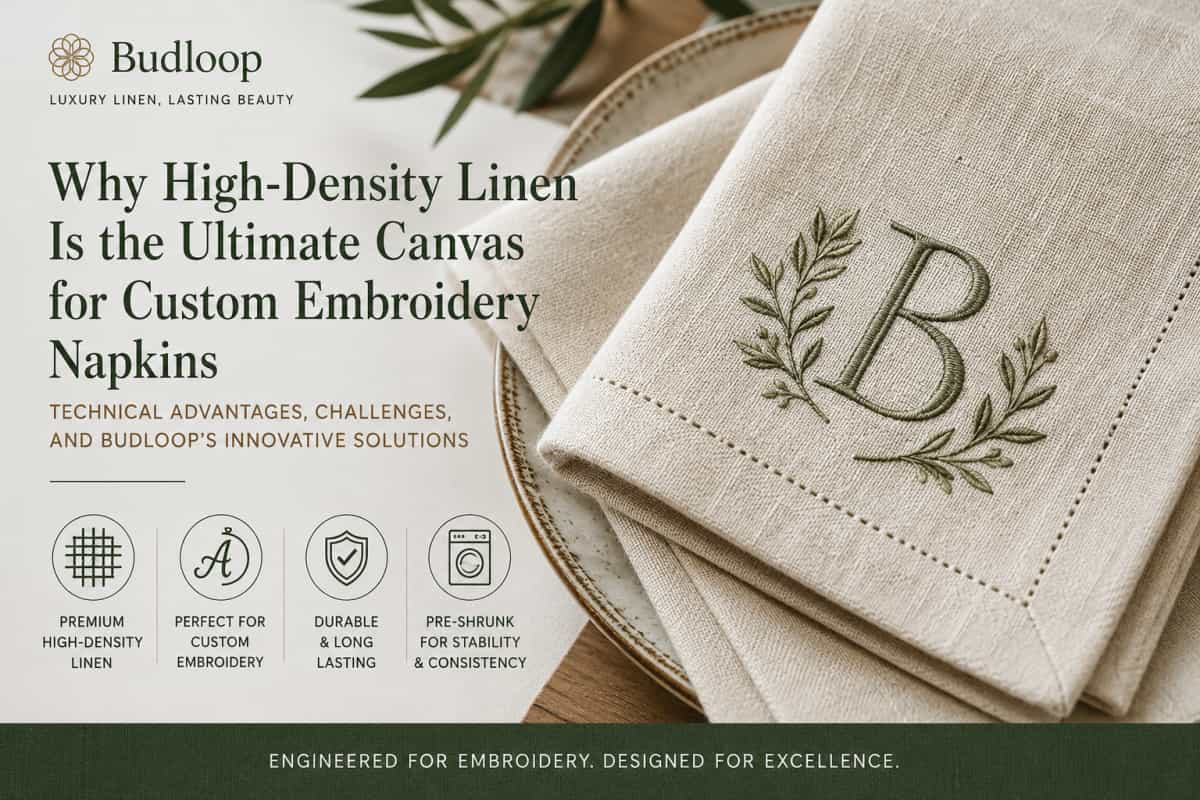
The Embroiderer’s Choice: Why High-Density Linen is the Gold Standard for Personalized Napkins
For embroidery artists and custom gift studios, the flawless presentation of a finished piece always begins with the choice of the base fabric. In the realm of bespoke tablescape art, linen is the undisputed synonym for premium quality. However, not all linen is created equal when it comes to serving as a reliable canvas for intricate embroidery.
Today, we will delve deep into why high-density linen has become the ultimate canvas of choice for professional custom embroidery napkin sellers, and how Budloop addresses the core technical bottlenecks encountered by North American and Canadian clients during the personalization process through proprietary techniques like our seamless double-layer hem.
1. Why Embroidery Favors Premium Linen
Many beginners tend to choose cotton due to its even, flat surface, making it the standard go-to material for entry-level projects. However, the cotton market suffers from severe homogenization, intense price competition, and highly compressed profit margins, making it ill-suited for mid-to-high-end brand positioning.
In contrast, experienced embroiderers recognize that premium linen napkin blanks have become the optimal choice for creating personalized textiles. Cotton lacks the inherent structural "body" and crispness found in linen. High-density linen features a tightly woven texture that effectively supports the tension of embroidery threads, and its linen fiber properties are one reason it is widely used in premium textile applications. Even in dense monogram designs, stitches remain flat and perfectly aligned without shifting, delivering unparalleled elegance and refinement.
1.1 Physical Parameters Comparison: Linen vs. Cotton Blanks for Custom Sourcing

| Comparison Dimension | 100% Pure Linen Napkin (170 GSM Double-Layer) |
Pure Cotton Napkin (170 GSM Double-Layer) |
Data Source / Standard |
|---|---|---|---|
| Dry Breaking Tensile Strength (Warp) | ≥ 600N (GB Qualified Requirement) | 450–600N (Industry Measured Average) | fabric tensile strength test zwickroell |
| Wet Strength Variance | Increases by 10%–20% | Decreases by approx. 10% | Textile Science Principles, Home Textile Durability Testing |
| Air Permeability | ≥ 120 mm/s | Approx. 100 mm/s | Home Textile Air Permeability Test Reports |
| Surface Texture | Natural slub texture, matte finish | Smooth and uniform, soft luster | Industry Consensus on Fabric Appearance |
| Wash Durability & Longevity | Fibers soften with repeated washing; strength remains uncompromised | Fibers fatigue over repeated laundering; strength gradually degrades | Home Textile Longevity Research |
| Raw Material Cost Multiplier | Approx. 1.35–1.8x the cost of equivalent GSM cotton | Baseline Value: 1.0 | Linen Supply Chain Cost Analysis, Home Textile Cost Structure Reports |
1.2 Material Advantages of the Linen "Canvas"
- Superior Strength & Enhanced Durability: Capable of enduring heavy embroidery threads, multi-layered stitch designs, and high-frequency commercial laundering, making it perfectly suited for commercial personalization settings across North America.
- Organic Slub Texture: The natural slub texture possesses an inherent artistic quality that significantly elevates the vintage, wabi-sabi, and artisanal feel of the finished piece. Personalized linen cocktail napkins command a retail price premium of over 60% compared to pure cotton in end-markets.
- Naturally Antibacterial & Quick-Drying: When utilized as premium monogrammed napkins, linen provides superior stain resistance and hygienic properties, aligning seamlessly with modern sustainable consumer trends.
2. Technical Bottlenecks in Embroidery and Customization
During the embroidery process, due to the inherent structural limitations of standard base fabrics, embroidery artists and custom gift studios frequently encounter the following operational challenges:
2.1 Registration Errors & Distortion Risks
Fabrics with loose plain weaves allow yarns to shift easily when pierced by commercial machine needles, leading to skipped stitches and design registration errors. Furthermore, excessive hoop tension can cause localized fabric stretching, which amplifies distortion once the fabric contracts after washing.
2.2 Edge Fraying & Increased Labor Steps
Once cut, fabric edges must be immediately overcast or bound. Otherwise, continuous unraveling occurs during production handling, which compromises precision and adds significant trimming labor hours and material waste during post-finishing.
2.3 Mismatched Shrinkage & Thread Tension
If the base fabric is not thoroughly pre-shrunk before embroidery, the subsequent contraction of the fabric during washing will not synchronize with the tension of the embroidery threads. This discrepancy triggers design puckering, stitch tension cracks, and edge curling, resulting in frequent post-sale quality complaints.
3. Budloop's Core Innovations: Golden GSM, Seamless Double-Fold Hems & Advanced Pre-Shrinkage

As an R&D-driven manufacturer specializing in the development and mass production of washed linen textiles, Budloop treats "fabric adaptation for embroidery applications" as a core dedicated research initiative. Following multiple iterations and hundreds of commercial-grade embroidery simulation tests, we have established a fully verified, reproducible stability framework across three dimensions: fabric structural engineering, pre-treatment processes, and proprietary edge construction.
3.1 Misalignment and Distortion? Rooted Out via the Golden GSM Architecture
Through hundreds of embroidery simulation runs, we have calibrated two "Golden GSM" weight intervals (160–170 GSM and 210–220 GSM) paired with an ultra-dense weave structure. This architecture preserves the soft, organic texture of washed linen while endowing the fabric with exceptional tensile strength.
When loaded onto commercial embroidery machines, the fabric tension remains uniform and highly controllable. Fibers do not slip upon needle penetration, preventing localized stretching, design distortion, or multi-color registration errors. Enhanced by warp-and-weft thermal setting before leaving the factory, the dimensional stability is vastly superior, restricting batch-to-batch variations to a microscopic margin to perfectly satisfy high-precision embroidery positioning.
3.2 Edge Fraying & Extra Labor Steps? Solved Instantly via Seamless Double-Fold Hems
Standard fabrics are highly prone to raw edges and loose threads after being pierced by dense embroidery needles, often requiring an extra overlocking or trimming step—which inflates costs and extends production lead times.
We have optimized our seamless double-fold hem process specifically for embroidery environments. During the finished fabric stage, the edges undergo a double-layered interlocking seal, completely enclosing edge fibers with zero exposed raw fringe. Post-embroidery, the fibers surrounding the needle penetrations remain secure without unraveling under structural stress. The edges stay perpetually clean and flat, removing any need for secondary finishing, directly reducing rework waste, and streamlining your production flow.
3.3 Shrinkage Discrepancy & Edge Curling? Tension Alignment via Advanced Pre-Shrinkage
We have engineered a proprietary, full-link pre-shrinkage and heat-setting production line. The fabric undergoes multiple rounds of professional washing, low-temperature relaxation drying, and tension balancing to prematurely release the residual internal stress of the flax fibers. This achieves a highly stabilized finished shrinkage rate of approximately 2% across both warp and weft directions.
During embroidery production, no extraordinary thread tension adjustments are required to achieve a flawless balance between thread and fabric. Even after subsequent consumer laundering cycles, the finished pieces will not suffer from flipped edges or puckered designs caused by differential shrinkage, preserving a flat, exquisite embroidered aesthetic for the long term.
4. Why Etsy Sellers and Personalization Businesses Prefer Linen Cocktail Napkins
4.1 Linen Helps Personalized Products Command Higher Prices
On Etsy, personalization is often associated with premium gifting experiences rather than mass-produced products. Compared with cotton or polyester alternatives, linen naturally communicates craftsmanship, quality, and attention to detail. Many sellers find that embroidered linen cocktail napkins can support higher retail pricing because customers perceive them as keepsake items rather than disposable event accessories.
4.2 Linen Creates a More Distinctive Embroidery Result
The subtle texture of linen adds visual depth that smooth fabrics often lack. Whether featuring a wedding monogram, family crest, custom logo, or handwritten signature, embroidery on linen tends to feel more artisanal and unique. This helps personalized products stand out in a crowded marketplace.
4.3 Linen Photographs Beautifully for Etsy Listings
Product photography plays a critical role in Etsy conversions. Natural linen reflects light softly and adds texture without overwhelming the embroidered design. As a result, many Etsy sellers use linen not only as the finished product but also as a styling element within their product photography.
4.4 Linen Supports Wedding and Luxury Gift Markets
Many of the fastest-growing personalization categories on Etsy are connected to:
- Weddings
- Bridal showers
- Housewarming gifts
- Anniversary gifts
- Family monograms
Linen aligns naturally with these categories because it conveys elegance, durability, and timelessness.
4.5 Reliable Blanks Reduce Production Problems
For personalization businesses, the quality of the blank product matters just as much as the embroidery itself. Consistent sizing, stable fabric construction, controlled shrinkage, and clean edge finishing help reduce production errors, minimize customer complaints, and improve repeat purchase rates.
4.6 Empowering Your Custom Business
The Budloop technical framework has been fully validated through large-scale production runs across multiple commercial embroidery facilities, home décor brands, and apparel labels throughout North America. The passing rate of finished embroidered items and their aesthetic stability post-wash have won unanimous praise from our clients. You can confidently promise your end consumers that the bespoke napkins they receive will maintain their flawless silhouette over repeated washes, rather than turning warped and misshapen after a single laundry cycle.
As a dedicated professional supplier, Budloop intimately understands the vital need of boutique custom studios for Low Minimum Order Quantities (Low MOQs) and rich color diversity. We do not merely offer OEKO-TEX® certified, food-safe linen; we provide a curated palette of over 50 distinct colorways, explicitly designed to help you craft pieces that align perfectly with the latest seasonal design trends (such as Cottagecore and Rustic Wedding aesthetics).
Frequently Asked Questions
1. What is the best fabric for embroidered cocktail napkins?
Linen is widely considered one of the best fabrics for embroidered cocktail napkins because it combines durability, stitch stability, and a naturally elegant texture. High-quality linen supports embroidery well while creating a premium finished appearance.For additional material context, see linen fiber properties
2. Why is linen preferred for personalized cocktail napkins?
Linen provides a distinctive natural texture that enhances monograms, initials, and custom embroidery. It is also durable, reusable, and suitable for both wedding and everyday entertaining applications.
3. Is linen better than cotton for embroidery?
Both linen and cotton can be embroidered successfully. Linen is often preferred for premium and luxury applications because of its texture, strength, and timeless appearance, while cotton typically offers a smoother surface.A useful reference for cotton characteristics is cotton fiber properties.
4. Can you embroider names on linen cocktail napkins?
Yes. Linen cocktail napkins are frequently personalized with names, initials, wedding dates, logos, family crests, and custom artwork.
5. Do embroidered linen napkins hold up after washing?
High-quality linen napkins can maintain their appearance through repeated washing when properly constructed and pre-shrunk. Stable fabric construction helps prevent distortion around embroidered areas.
6. What size cocktail napkin is best for embroidery?
The most common embroidered cocktail napkin sizes range from 6 × 6 inches to 10 × 10 inches. Monograms and initials work particularly well on standard cocktail napkin sizes.
7. What can be embroidered on a cocktail napkin?
Popular embroidery options include:
- Couple initials
- Wedding dates
- Family monograms
- Custom logos
- Floral motifs
- Signature cocktail names
- Personalized messages
8. What is the difference between embroidered and printed cocktail napkins?
Embroidery uses thread stitched directly into the fabric, creating texture and durability. Printing applies ink or pigment to the surface. Embroidered napkins generally offer a more premium and long-lasting appearance.
9. Are linen cocktail napkins suitable for machine embroidery?
Yes. High-density linen is commonly used for machine embroidery because it provides good fabric stability and supports clean stitch formation.
10. Why do luxury wedding planners choose linen napkins?
Luxury wedding planners often select linen because of its natural texture, sophisticated appearance, and ability to complement high-end table settings and event photography.
11. Why is high-density linen better than cotton for custom embroidery?
High-density linen provides a superior "structural skeleton" for embroidery. Unlike cotton, which can be soft and prone to shifting, high-density linen maintains tension during the stitching process, preventing puckering or pattern distortion. It is the preferred choice for artisans aiming for high-end, crisp monograms and intricate designs.
12. Will linen napkins shrink after being embroidered and washed?
Shrinkage is a common concern with natural fibers, which is why Budloop uses a professional pre-washing process. Our pre-washed linen minimizes shrinkage, ensuring your embroidery remains perfectly aligned and intact even after repeated washing—giving your clients a professional, durable product.
13. How does edge construction affect embroidery quality?
Clean solid-edge construction provides a stable, reinforced border that prevents edge curling during machine embroidery. This dual-layer structure acts as a stabilizer, allowing artisans to embroider closer to the edges without the fabric bunching or distorting, which is crucial for professional-grade finishing.
14. What are the best blank cocktail napkins for monogram embroidery?
The best blank cocktail napkins for monogram embroidery are made from high-quality natural fibers and feature stable construction that supports clean stitch formation.
Key characteristics to look for include:
- Medium to high fabric density
- Consistent sizing across production batches
- Clean finished edges
- Pre-shrunk fabric construction
- Smooth embroidery performance
- Good wash durability
Linen cocktail napkins are particularly popular for monogram embroidery because they combine durability with a refined natural texture that enhances personalized designs.
15. Can Etsy sellers buy blank linen cocktail napkins in small quantities?
Yes. Budloop is designed specifically for small businesses and customization studios. We offer low minimum order quantities (MOQ starting at 20 pcs) with mix-and-match color options, allowing you to manage your inventory effectively without high upfront costs.
5. Want to Test Your Embroidery Stitches Firsthand?
Don't just take our word for it—experience this exceptional texture with your own hands. We warmly invite embroidery artists and Etsy creators to apply for our exclusive "Maker’s Sample Kit" to help you discover the absolute perfect tension setting for your machinery.
Start Your Professional Partnership
Let every piece you create become a treasured masterpiece in the hearts of your clients.
Click Here to Apply for Your Maker's Sample Kit

Leave a comment
This site is protected by hCaptcha and the hCaptcha Privacy Policy and Terms of Service apply.